Interesting news from the Union-Tribune today. A group of architects wants to renovate Qualcomm Stadium, regardless of whether the Chargers play there in the future or not.
According to one of the group's members, Jack Carpenter - a fitting name, I must add - the stadium isn't as bad as it has been made out to be, and with some fixing up the stadium will be great for San Diego State football and soccer matches.
Their wish is put a presentation in front of Qualcomm Stadium Advisory Board. A member of that group said that they would listen to what the architects had to say.

Friday, February 15, 2008
Architects look to renovate Qualcomm


Wednesday, February 13, 2008
Impact Players: Mark Fabiani
Tags:
Feature,
Impact Players
This is the first in a series showcasing the main figures in the negotiations.
Mark Fabiani is Special Counsel to the President for the San Diego Chargers.
###
An attorney is like a reused envelope.
The sides are bent and scuffed from the abuse it has taken over the days. The paper doesn’t shine as bright from the clutter that’s been placed on top of it. The opening needs a sticker to keep the fold down since the mint stripe has worn away. Whiteout hangs and cracks on top of the countless addresses, and labels that never wear off blanket the outside.
But inside the envelope, through the bends and nicks, fresh paper resides – still bright, sharp and unbroken, available for the next person to open it up and learn from the contents. And if the reader isn’t careful, they’ll feel the sting of a long paper cut down their hand. It is the pain of underestimating what is in front of them.
Mark Fabiani’s envelope is still sharp – at least the San Diego Chargers hope it is.
The sides are bent and scuffed from the abuse it has taken over the days. The paper doesn’t shine as bright from the clutter that’s been placed on top of it. The opening needs a sticker to keep the fold down since the mint stripe has worn away. Whiteout hangs and cracks on top of the countless addresses, and labels that never wear off blanket the outside.
But inside the envelope, through the bends and nicks, fresh paper resides – still bright, sharp and unbroken, available for the next person to open it up and learn from the contents. And if the reader isn’t careful, they’ll feel the sting of a long paper cut down their hand. It is the pain of underestimating what is in front of them.
Mark Fabiani’s envelope is still sharp – at least the San Diego Chargers hope it is.
#
Fabiani’s official title is Special Counsel to the President. A better title would be The Voice.
“One of things that we started to do,” Fabiani said, “and still do now, is go out in the community. We go to as many events as we can, whether it's rotary clubs, lunches or ... inviting a group of people who frequent message boards and follow the team really closely on the Internet. “
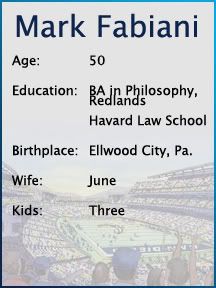
He is the master of the Chargers’ message to the community about putting a stadium in San Diego County. He represents the thoughts of the Spanos family that own and run the team, and is the point man for any public meeting that wants to talk stadium issues. While men like LaDainian Tomlinson and Shawne Merriman garner the most headlines, it is Fabiani’s words that are crucial to the future of the team.
The story of Mark Fabiani isn’t static to San Diego. Fabiani is well-traveled, well-known, and in several cases, infamous. His past hires range from politics to sports to entertainment, so much so that his personal history reads like a textbook. If the life of this 50-year-old is like that of a quarterback, Fabiani is not a training camp rookie. He’s an established veteran, a kickoff weekend starter.
This profile doesn’t dwell in policy and numbers. Walk into any of the speeches Mark Fabiani’s been giving over the last six years and the numbers will be sitting there. This is about the Mark Fabiani you don’t know. The Fabiani that picked up the pieces of Clinton’s broken home. The Fabiani that united with Dean Spanos by proximity before publicity. The Fabiani that gives more reasons why a stadium in Chula Vista doesn’t work than why it can.
This is why Mark Fabiani is an impact player.
Fabiani’s official title is Special Counsel to the President. A better title would be The Voice.
“One of things that we started to do,” Fabiani said, “and still do now, is go out in the community. We go to as many events as we can, whether it's rotary clubs, lunches or ... inviting a group of people who frequent message boards and follow the team really closely on the Internet. “
He is the master of the Chargers’ message to the community about putting a stadium in San Diego County. He represents the thoughts of the Spanos family that own and run the team, and is the point man for any public meeting that wants to talk stadium issues. While men like LaDainian Tomlinson and Shawne Merriman garner the most headlines, it is Fabiani’s words that are crucial to the future of the team.
The story of Mark Fabiani isn’t static to San Diego. Fabiani is well-traveled, well-known, and in several cases, infamous. His past hires range from politics to sports to entertainment, so much so that his personal history reads like a textbook. If the life of this 50-year-old is like that of a quarterback, Fabiani is not a training camp rookie. He’s an established veteran, a kickoff weekend starter.
This profile doesn’t dwell in policy and numbers. Walk into any of the speeches Mark Fabiani’s been giving over the last six years and the numbers will be sitting there. This is about the Mark Fabiani you don’t know. The Fabiani that picked up the pieces of Clinton’s broken home. The Fabiani that united with Dean Spanos by proximity before publicity. The Fabiani that gives more reasons why a stadium in Chula Vista doesn’t work than why it can.
This is why Mark Fabiani is an impact player.
#
If Mark Fabiani hadn’t settled in La Jolla, this article may not exist.
The Spanos family did not find Mark Fabiani by looking in the phone booth. The two sides had kept contact in bits and pieces starting in the late ‘90s. They may have never met, however, if the NFL hadn’t found Fabiani convenient.
“After I left the White House the NFL called me,” Fabiani said. “They said 'You handled all the problems for Clinton, would you like to give a Crisis Management presentation?’ They were holding the conference in San Diego, so it was an inexpensive choice for them.
“I guess they liked it and they mentioned me to the Chargers. I went over and met Dean and did some projects, nothing too significant. I did some smaller projects for them.”
But one day in April of 2002, Fabiani went from outside help to inside man.
“I got a call from Dean,” Fabiani recollected. “He said 'I need to see you right away.'
If Mark Fabiani hadn’t settled in La Jolla, this article may not exist.
The Spanos family did not find Mark Fabiani by looking in the phone booth. The two sides had kept contact in bits and pieces starting in the late ‘90s. They may have never met, however, if the NFL hadn’t found Fabiani convenient.
“After I left the White House the NFL called me,” Fabiani said. “They said 'You handled all the problems for Clinton, would you like to give a Crisis Management presentation?’ They were holding the conference in San Diego, so it was an inexpensive choice for them.
“I guess they liked it and they mentioned me to the Chargers. I went over and met Dean and did some projects, nothing too significant. I did some smaller projects for them.”
But one day in April of 2002, Fabiani went from outside help to inside man.
“I got a call from Dean,” Fabiani recollected. “He said 'I need to see you right away.'
“Actually, I had just gone to the gym and I was in my workout clothes. I said, 'Dean, let me go take a shower and I'll see you later.'
“But he said, 'No, come on over. Let’s meet over here and I can talk to you.’
 “We met at the lobby at the LaValencia Hotel and he told me, 'You’ve got to consider helping us on an issue.’ I said, 'What is that?’
He said, ‘We had a big meeting with our family and we decided we really want to try and keep the team in San Diego, but eventually we’re going to need a new stadium to do that. We don't need a new stadium tomorrow, or next week, or next year, but eventually we need a new stadium and it takes a while to get these things done and we want you to get started.’
“At the time, there were all these rumors about Los Angeles and a stadium being built in downtown. The team had moved its training camp to Carson.
“I said to Dean at the time, ‘You know, in my opinion, if you want to move the team, you should just move the team. You have a lease that allows you to do that. You're in a situation where it allows you to do that. If you just want to move the team, you should just move it.’
“And he said, 'I understand that, but that's not what I want to do. We want to try to keep the team here.’
“I said, "Your timing is not good. You've got a ticket guarantee that's making everybody mad. Your training camp is in Carson, and that’s making everybody mad. You've got a renovation that happened at Qualcomm in the ‘90s that the city is still paying for. People are not going to be anxious to be talking to us about a new stadium.’
“He said, ‘I understand that. We have a lot of things to do, and that's why we need to get started.’"
“But he said, 'No, come on over. Let’s meet over here and I can talk to you.’
“We met at the lobby at the LaValencia Hotel and he told me, 'You’ve got to consider helping us on an issue.’ I said, 'What is that?’He said, ‘We had a big meeting with our family and we decided we really want to try and keep the team in San Diego, but eventually we’re going to need a new stadium to do that. We don't need a new stadium tomorrow, or next week, or next year, but eventually we need a new stadium and it takes a while to get these things done and we want you to get started.’
“At the time, there were all these rumors about Los Angeles and a stadium being built in downtown. The team had moved its training camp to Carson.
“I said to Dean at the time, ‘You know, in my opinion, if you want to move the team, you should just move the team. You have a lease that allows you to do that. You're in a situation where it allows you to do that. If you just want to move the team, you should just move it.’
“And he said, 'I understand that, but that's not what I want to do. We want to try to keep the team here.’
“I said, "Your timing is not good. You've got a ticket guarantee that's making everybody mad. Your training camp is in Carson, and that’s making everybody mad. You've got a renovation that happened at Qualcomm in the ‘90s that the city is still paying for. People are not going to be anxious to be talking to us about a new stadium.’
“He said, ‘I understand that. We have a lot of things to do, and that's why we need to get started.’"
#
The real story of Mark Fabiani doesn’t start with meetings at fancy hotels. The story of Mark Fabiani starts with long stretches of brick buildings, open greens, nature trails and the hum of steel mills and limestone. His journey starts in Ellwood City, Pa.
“It's the cradle of the quarterback,” Fabiani said. “I lived in Beaver Falls, Joe Namath's hometown. We moved to California with my parents when I was a teenager, and we lived in Ontario.”
Even though Fabiani spent his teenage years in Southern California and graduated from the University of the Redlands, he still looked back to the East. His future was not set with a bachelor’s degree in philosophy. Something else needed to be done.
The answer? Harvard Law School.
“I went to college and a lot of my friends were going to law school, and at the time it seemed like the right thing to do,” Fabiani said. “I don't know if it was at the time, but it seemed like it was.
“At the time Harvard had the best law school. It was cold back there though. It was cold in Pennsylvania too, but I had live on the West Coast for a while. It was a shock. It was a good place to go to college. I wouldn't want to live there, but it was a great place to go.”
Like most graduated of law school, Fabiani dove into a firm and began his life as an attorney. But in the midst of a stable career, inklings of doubt began to crawl in his mind. The private sector was not holding his interest. A life of law firm service didn’t seem like the right direction.”
“I came back to the West Coast and clerked for a federal judge on the ninth circuit,” Fabiani said. “A great man named Stephen Reinhardt.”
Judge Reinhardt has only been appointed to the Ninth Circuit for a short time, having previously worked with the Los Angeles Police Commission. Before that, however, he worked with Tom Bradley, who at the time was the mayor of Los Angeles. And when Fabiani needed to regain focus, the judge knew exactly what direction to turn Fabiani.
“I ended up staying in LA and starting working in a law firm,” Fabiani said. “I didn't really like practicing law. I was kind of bored with it. So I went back to see my old friend and told him my situation. He said 'Well, I've got an old friend, Mayor Bradley, and he's looking for some help, and if you want to do something different, go talk to him. Fortunately he liked me, and I went to go work with him.”
Fabiani went to work, and his role of mixing private and public sector problems put him on the map. He became deputy mayor and chief of staff during the last four years of Bradley’s stay in office.
 Fabiani wouldn’t stay out of work long. He would jump from local politics to the big stage – working with President Clinton through the 1996 election. He was in front of the national media constantly discussing the Whitewater scandal. Along with that role, he helped shape strategies for the Clintons. He didn’t return to the public spotlight until the turn of the century when worked for Al Gore’s campaign as a strategist and spokesperson.
For Fabiani, working with the media is what has stayed the same throughout all his jobs.
“The principles are all the same - whether it's a sports job or a government job or a campaign,” Fabiani said. “You've got to understand that the media is delayed as the public gets information. You have to respect that people that work in the media. And by media, I now include the blog world and the message boards. You have to be willing to work with them, or else your information is not going to be able to get out. Whether it's any kind of issue, you've got to work with the people who generate the information.”
When asked whether he preferred the established position with Clinton or the unsettling and exciting campaign with Gore, Fabiani actually points to the Bradley days are most satisfying.
“When you're working in Washington, it's sometimes difficult to see if your job is producing any results,” Fabiani said. “You're far away from where things really happen at the local level. There's a lot of bureaucracy. My job with the mayor was a great job because everyday you could see if you were having ... a good effect of a bad effect on people. Washington was pretty far removed.
“A presidential campaign is totally different. You can measure on a day-to-day basis how you're doing. Whether you've got good press coverage, bad press coverage, you can look at how the crowds are. Immediate results are known to you.
“However, it's grueling. It's 20 hours a day, seven days a week for months and months and months. It's not something you can do forever.”
It was here that he met his future firm partner Chris Lehane. The two met in the White House, and their relationship carried over into a long-term – and infamous – partnership.
“I met him at the White House when I worked with Clinton,” Fabiani said. “I left for California, and he stayed and became Al Gore's secretary. I left and he stayed, but we obviously stayed in touch. I started on my own firm in 1997 in San Diego. I took a leave of absence to work on the Gore campaign. I worked for Gore until the bitter end in December, and then I joined up with Chris the following spring.”
Fabiani and Lehane have worked with a variety of people, including the NHL and filmmaker Michael Moore.
“[Chris is] a good guy, he's great to work with, and I feel fortunate to be able to work with him,” Fabiani said. “We've been fortunate to have a lot of interesting clients, interesting business, and I have no complaints.”
The real story of Mark Fabiani doesn’t start with meetings at fancy hotels. The story of Mark Fabiani starts with long stretches of brick buildings, open greens, nature trails and the hum of steel mills and limestone. His journey starts in Ellwood City, Pa.
“It's the cradle of the quarterback,” Fabiani said. “I lived in Beaver Falls, Joe Namath's hometown. We moved to California with my parents when I was a teenager, and we lived in Ontario.”
Even though Fabiani spent his teenage years in Southern California and graduated from the University of the Redlands, he still looked back to the East. His future was not set with a bachelor’s degree in philosophy. Something else needed to be done.
The answer? Harvard Law School.
“I went to college and a lot of my friends were going to law school, and at the time it seemed like the right thing to do,” Fabiani said. “I don't know if it was at the time, but it seemed like it was.
“At the time Harvard had the best law school. It was cold back there though. It was cold in Pennsylvania too, but I had live on the West Coast for a while. It was a shock. It was a good place to go to college. I wouldn't want to live there, but it was a great place to go.”
Like most graduated of law school, Fabiani dove into a firm and began his life as an attorney. But in the midst of a stable career, inklings of doubt began to crawl in his mind. The private sector was not holding his interest. A life of law firm service didn’t seem like the right direction.”
“I came back to the West Coast and clerked for a federal judge on the ninth circuit,” Fabiani said. “A great man named Stephen Reinhardt.”
Judge Reinhardt has only been appointed to the Ninth Circuit for a short time, having previously worked with the Los Angeles Police Commission. Before that, however, he worked with Tom Bradley, who at the time was the mayor of Los Angeles. And when Fabiani needed to regain focus, the judge knew exactly what direction to turn Fabiani.
“I ended up staying in LA and starting working in a law firm,” Fabiani said. “I didn't really like practicing law. I was kind of bored with it. So I went back to see my old friend and told him my situation. He said 'Well, I've got an old friend, Mayor Bradley, and he's looking for some help, and if you want to do something different, go talk to him. Fortunately he liked me, and I went to go work with him.”
Fabiani went to work, and his role of mixing private and public sector problems put him on the map. He became deputy mayor and chief of staff during the last four years of Bradley’s stay in office.
Fabiani wouldn’t stay out of work long. He would jump from local politics to the big stage – working with President Clinton through the 1996 election. He was in front of the national media constantly discussing the Whitewater scandal. Along with that role, he helped shape strategies for the Clintons. He didn’t return to the public spotlight until the turn of the century when worked for Al Gore’s campaign as a strategist and spokesperson.For Fabiani, working with the media is what has stayed the same throughout all his jobs.
“The principles are all the same - whether it's a sports job or a government job or a campaign,” Fabiani said. “You've got to understand that the media is delayed as the public gets information. You have to respect that people that work in the media. And by media, I now include the blog world and the message boards. You have to be willing to work with them, or else your information is not going to be able to get out. Whether it's any kind of issue, you've got to work with the people who generate the information.”
When asked whether he preferred the established position with Clinton or the unsettling and exciting campaign with Gore, Fabiani actually points to the Bradley days are most satisfying.
“When you're working in Washington, it's sometimes difficult to see if your job is producing any results,” Fabiani said. “You're far away from where things really happen at the local level. There's a lot of bureaucracy. My job with the mayor was a great job because everyday you could see if you were having ... a good effect of a bad effect on people. Washington was pretty far removed.
“A presidential campaign is totally different. You can measure on a day-to-day basis how you're doing. Whether you've got good press coverage, bad press coverage, you can look at how the crowds are. Immediate results are known to you.
“However, it's grueling. It's 20 hours a day, seven days a week for months and months and months. It's not something you can do forever.”
It was here that he met his future firm partner Chris Lehane. The two met in the White House, and their relationship carried over into a long-term – and infamous – partnership.
“I met him at the White House when I worked with Clinton,” Fabiani said. “I left for California, and he stayed and became Al Gore's secretary. I left and he stayed, but we obviously stayed in touch. I started on my own firm in 1997 in San Diego. I took a leave of absence to work on the Gore campaign. I worked for Gore until the bitter end in December, and then I joined up with Chris the following spring.”
Fabiani and Lehane have worked with a variety of people, including the NHL and filmmaker Michael Moore.
“[Chris is] a good guy, he's great to work with, and I feel fortunate to be able to work with him,” Fabiani said. “We've been fortunate to have a lot of interesting clients, interesting business, and I have no complaints.”
#
“For the first two years, our efforts were on cleaning up the mess.”
Fabiani’s start with the team wasn’t a time to relax. Work was to be done immediately, and he had to play catch-up for a situation already under duress.
“[There was] getting rid of the ticket guarantee,” Fabiani said, “getting rid of the trigger, getting rid of the litigation, getting rid of the bad relationship between the city and team and getting rid of the bad feelings between the team and the community about the ticket guarantee. I learned that quickly when I started giving speeches. It was a very difficult time.
The team worked with the city to solve the problems, giving each side the chance to finally listen to one another without anything in the way.
“We did clean them up finally,” Fabiani said, “and by the summer of 2004 we had renegotiated our lease with the city, we had eliminated the ticket guarantee and we had moved the training camp back. We had done everything they had asked us to do. We got our new lease signed, and the members of the City Council said ‘Now we can talk about a new stadium.’
“And then everything went to hell in a hand basket with the city.”
 The rest of the story doesn’t need to be retold here. The government collapsed, the stadium went on the backburner, and eventually the hope surrounding the project lowered faster than the sun setting over La Jolla Shores. Even now, with all eyes supposedly stuck on Chula Vista’s bayfront, the questions over Qualcomm have never quelled.
“The number one question I get is ‘Why not Qualcomm?’” Fabiani said. “It's like we worked on Qualcomm so long that people forget we worked on it.”
“The answer is pretty simple - when we proposed this … that proposal involved funding a project for a stadium that costs $400 million and infrastructure that costs about $175 million. But now, you're talking about a project that's going to cost double that. And how in the world, even if Mike Aguirre weren't around, even if Mayor Sanders suddenly became interested in our project, even if those issues went away - how in the world do you generate enough revenue off of the Qualcomm site to pay for that kind of huge project? You can't build 30,000 condos on the Qualcomm site. You can only do so much.”
“We would love to stay in Qualcomm. But the truth of the matter is that it doesn't work. If there was another source of funding, would it work? Yes, but there isn't.”
“For the first two years, our efforts were on cleaning up the mess.”
Fabiani’s start with the team wasn’t a time to relax. Work was to be done immediately, and he had to play catch-up for a situation already under duress.
“[There was] getting rid of the ticket guarantee,” Fabiani said, “getting rid of the trigger, getting rid of the litigation, getting rid of the bad relationship between the city and team and getting rid of the bad feelings between the team and the community about the ticket guarantee. I learned that quickly when I started giving speeches. It was a very difficult time.
The team worked with the city to solve the problems, giving each side the chance to finally listen to one another without anything in the way.
“We did clean them up finally,” Fabiani said, “and by the summer of 2004 we had renegotiated our lease with the city, we had eliminated the ticket guarantee and we had moved the training camp back. We had done everything they had asked us to do. We got our new lease signed, and the members of the City Council said ‘Now we can talk about a new stadium.’
“And then everything went to hell in a hand basket with the city.”
The rest of the story doesn’t need to be retold here. The government collapsed, the stadium went on the backburner, and eventually the hope surrounding the project lowered faster than the sun setting over La Jolla Shores. Even now, with all eyes supposedly stuck on Chula Vista’s bayfront, the questions over Qualcomm have never quelled.“The number one question I get is ‘Why not Qualcomm?’” Fabiani said. “It's like we worked on Qualcomm so long that people forget we worked on it.”
“The answer is pretty simple - when we proposed this … that proposal involved funding a project for a stadium that costs $400 million and infrastructure that costs about $175 million. But now, you're talking about a project that's going to cost double that. And how in the world, even if Mike Aguirre weren't around, even if Mayor Sanders suddenly became interested in our project, even if those issues went away - how in the world do you generate enough revenue off of the Qualcomm site to pay for that kind of huge project? You can't build 30,000 condos on the Qualcomm site. You can only do so much.”
“We would love to stay in Qualcomm. But the truth of the matter is that it doesn't work. If there was another source of funding, would it work? Yes, but there isn't.”
#
Six years after Fabiani signed on, more than a decade after meeting Dean Spanos, he’s still working on the same project he gave listening tours for, the same project he wrote statements on, the same project he has seen rise and fall. The stadium negotiations has come and gone from city to city, taking its imaginary pencil and crossing off each place it travels.
Now it sits at the bayfront’s shores and on the Eastside’s expanse. But is this southland ready to sign on the line instead of scratch off its name?
“We've got a lot of land,” Fabiani said. “You're talking about 130 acres on the waterfront. You're talking about 500 acres on the east side. It is very different from the Qualcomm site where you're trying to fit everything on 166 acres of land, only 60 acres of which are developable.”
Land is only one factor out of many other important topics. Land may be the only one Fabiani can cheerfully answer with full confidence.
“There are a lot of reasons why it might not work,” Fabiani said. “It might not work because there might not be a firm base for the shutdown of the power plant. It might not work because even if the plant is shut down, there might be environmental issues that might keep us from using the bayfront site. It might not work because you may never get through the gauntlet of government agencies that you've got to deal with, from the Coastal Commission to the Port Commission to various state agencies and the city of Chula Vista. That's something we have a difficult time explaining.”
And on top of that, someone has to foot the bill – and in California, don’t look at the taxpayers to fill the void.
“It might not work because no one's ever done this before, building a privately financed stadium,” Fabiani said. “It might not be possible to generate the efficient revenue to build [this]. The cost has clearly gone in the opposite direction of where we need it to be. You've got soaring construction costs. You've got a project that costs double what it costs six years ago.”
 But Fabiani does have hope on his side. Even thought the stadium project may not be the most famous thing he’s ever done, and even though it probably isn’t the most exciting thing he’s ever faced, it does has something for him to hang onto. For Fabiani, this project is a replica of how he likes to live his life.
Fabiani has never stuck to tradition. From going across the country once and back again, to not following in his Harvard footsteps, to working his way up the ladder in a way uncommon to most of his peers, why shouldn’t a stadium depending heavily on his voice take the most controversial route for its birth?
“Most people get out of law school and go into a law firm,” Fabiani said, “and I went into the government and it was the best choice I could have made. I don't really have any advice for anyone except ‘Don't always follow the traditional path. Sometimes you might do something that's out of the ordinary and it might turn out very well.’”
If an attorney is an envelope, Mark Fabiani can’t wait to deliver.
Six years after Fabiani signed on, more than a decade after meeting Dean Spanos, he’s still working on the same project he gave listening tours for, the same project he wrote statements on, the same project he has seen rise and fall. The stadium negotiations has come and gone from city to city, taking its imaginary pencil and crossing off each place it travels.
Now it sits at the bayfront’s shores and on the Eastside’s expanse. But is this southland ready to sign on the line instead of scratch off its name?
“We've got a lot of land,” Fabiani said. “You're talking about 130 acres on the waterfront. You're talking about 500 acres on the east side. It is very different from the Qualcomm site where you're trying to fit everything on 166 acres of land, only 60 acres of which are developable.”
Land is only one factor out of many other important topics. Land may be the only one Fabiani can cheerfully answer with full confidence.
“There are a lot of reasons why it might not work,” Fabiani said. “It might not work because there might not be a firm base for the shutdown of the power plant. It might not work because even if the plant is shut down, there might be environmental issues that might keep us from using the bayfront site. It might not work because you may never get through the gauntlet of government agencies that you've got to deal with, from the Coastal Commission to the Port Commission to various state agencies and the city of Chula Vista. That's something we have a difficult time explaining.”
And on top of that, someone has to foot the bill – and in California, don’t look at the taxpayers to fill the void.
“It might not work because no one's ever done this before, building a privately financed stadium,” Fabiani said. “It might not be possible to generate the efficient revenue to build [this]. The cost has clearly gone in the opposite direction of where we need it to be. You've got soaring construction costs. You've got a project that costs double what it costs six years ago.”
But Fabiani does have hope on his side. Even thought the stadium project may not be the most famous thing he’s ever done, and even though it probably isn’t the most exciting thing he’s ever faced, it does has something for him to hang onto. For Fabiani, this project is a replica of how he likes to live his life.Fabiani has never stuck to tradition. From going across the country once and back again, to not following in his Harvard footsteps, to working his way up the ladder in a way uncommon to most of his peers, why shouldn’t a stadium depending heavily on his voice take the most controversial route for its birth?
“Most people get out of law school and go into a law firm,” Fabiani said, “and I went into the government and it was the best choice I could have made. I don't really have any advice for anyone except ‘Don't always follow the traditional path. Sometimes you might do something that's out of the ordinary and it might turn out very well.’”
If an attorney is an envelope, Mark Fabiani can’t wait to deliver.
###
Wednesday, February 6, 2008
Release from FTB Alliance cheers Chula Vista, jeers San Diego city
Tags:
Grassroots,
Headlines,
Politics
The Fans, Taxpayers and Business Alliance, a community coalition put together to place a stadium in San Diego County, put out this message earlier. In it, they praise the Chula Vista City Council for their service and denounce the city of San Diego's handling of stadium issues.
---
HATS OFF TO MAYOR COX AND THE ENTIRE CHULA VISTA CITY COUNCIL
The nationwide Neilson ratings released on Monday shows this year’s Super Bowl as the second most watched program ever in the history of United States television. But, a little known fact is that the Chargers AFC Championship game against the Patriots garnered a larger local rating than the Super Bowl did.
The conversation has never been about keeping the Chargers here at all costs, it has always been about working through the issues to see if it is possible to do so in a financially responsible way. Absent any meaningful conversation with the City of San Diego, Chula Vista has stood tall in saying they would at least study the issue.
Yet the City of San Diego, who stands to gain the most by finding a reasonable solution, is defiantly silent in how they might assist Chula Vista in retaining the team in the region. No time, no money, obviously no interest, not even in how to stint the ongoing cash drain as the City continues to pay about $19 million per year to maintain Qualcomm Stadium. (San Diego Union-Tribune, October 9, 2005)
Not one elected official in the City of San Diego has taken a public position on how to assist in solving the issue.
In music, that is called tone-deaf.
No matter what side of the issue you are on, it is important to let the local political leadership know what you think. Be sure to log onto www.ftballiance.org to contact your elected officials or send a letter to the Union-Tribune, Voice of San Diego or Chula Vista Star-News.
Fabiani open to discuss Terminal site
Brandon Stone
San Diego StadiumWatch
Chargers spokesman Mark Fabiani is open to stadium ideas about the proposed deck on the 10th Avenue Terminal.
"We are always open to any new and promising idea," Fabiani said, "and we meet with people all the time who call us with thoughts and plans."
Last week, San Diego Community Solutions announced their desire to build a deck at the terminal, saying it would help maritime service in San Diego Bay and allow for more parking downtown. SDCS is working with engineering company CH2M Hill to develop the terminal space.
"We will be happy to meet with anyone and everyone who wants to help," Fabiani said. "In the end, we aren’t going to do anything that is against the interests of our friends in organized labor. Nor do we want to become bogged down in a dispute with the Port Commission or other government agencies."
Fabiani's main concern is the cost of building on top of the deck.
"The kind of deck being talked about is enormously expensive to build," Fabiani said. "The New York Jets proposed a similar deck over the rail yards on Manhattan’s west side, and cost estimates for the deck were in the many hundreds of millions of dollars."
Scott Maloni, public affairs consultant for San Diego Community Solutions, has the same concerns.
“The odds of the stadium there are slim,” he said. “The finances aren’t put together … there’s not enough events. I’m not sure a football stadium makes sense.”
According to Maloni, the goal of the measure isn’t to instantly build on the terminal, but to amend the master plan to allow construction on the terminal. The group has started collecting signatures in the five cities that represent the Port Commission, which runs the area. If the group collects enough votes, the deck proposal could be on the November ballot.
“The initiative doesn’t have a project, it has a process,” Maloni said. “Some of the building could be for a convention center or for hotels or a sports arena. It could be a stadium.”
“It is premature to get caught up in any project,” he said.
Tuesday, February 5, 2008
Stadium not in 10th Avenue plans, group says
SDCS says terminal vote is "process, not project"
Brandon Stone, San Diego StadiumWatch
Building a stadium as part of a double deck on the 10th Avenue Marine Terminal is not in the big picture of the proposal, according to a group spokesperson.
“The odds of the stadium there are slim,” Scott Maloni, public affairs consultant for the private group San Diego Community Solutions, said. “The finances aren’t put together … there’s not enough events. I’m not sure a football stadium makes sense.”
SDCS announced their desire to build a deck at the site last week, citing that it would upgrade maritime services in San Diego Bay and allow for more parking downtown. The Port Commission would decide what structures could go on top of the deck, including hotels, parks or a convention center. SDCS has been working with engineering company CH2M Hill to develop innovative designs for the terminal space.
“The concept is that you maintain the terminal on the lower level,” Maloni said. “You would take advantage of the vertical space. There’s a vision of a monstrosity on the bay, but it is not like that.”
“It’s one of the most fantasized areas on the bay,” Maloni said. “One side says that it should always be a maritime terminal and the other says that it’s a waste. We’re mutual. We think you can do both.”
Maloni said that the group’s goal is to redevelop the area for both maritime and public use, respecting both those who want the land for industry and those who want to create something new. According to Maloni, the goal of the measure isn’t to instantly build on the terminal, but to amend the master plan to allow construction on the terminal.
“The initiative doesn’t have a project, it has a process,” Maloni said. “Some of the building could be for a convention center or for hotels or a sports arena. It could be a stadium.”
“It is premature to get caught up in any project,” he said.
The group has started collecting signatures in the five cities that represent the Port Commission, which runs the area. If the group collects enough votes, the deck proposal could be on the November ballot.
“The measure creates a process with specific criteria and timeframe to find a developer,” Maloni said.
Contact with both port and Chargers officials have not been made as of this time, but their response will be covered if there is comment.
A Morning On The Bay
Tags:
Feature
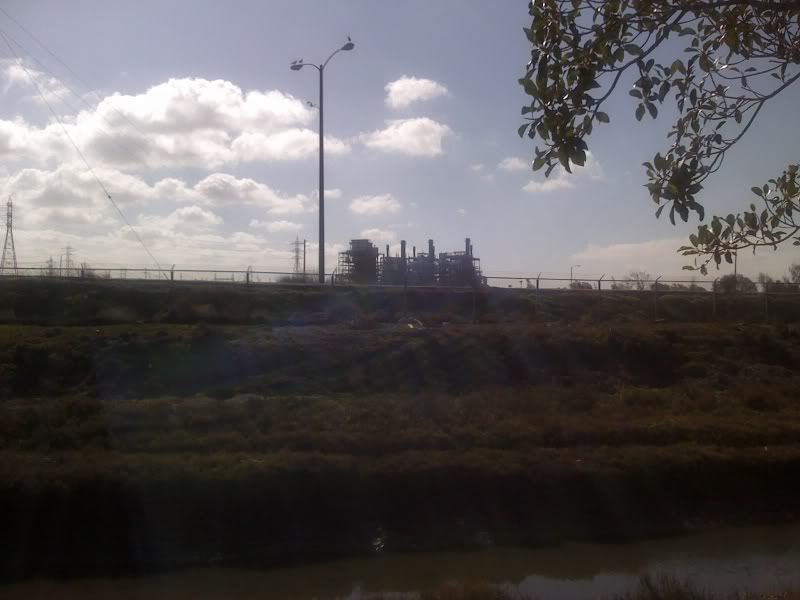
I stood on a rock listening to the sounds of the birds along the muddy banks as the smell of ocean coasted through the air on Bayfront Park.
Streaks of sun reflected down from the dull blue sky. The sound of the water slapping against the marsh was only broken in moments by fishing trucks driving along the road and planes roaring above. Dogs ran through grassy stretches while one man practiced Tai Chi along the water’s edge. People jogged and biked, boats launched, couples talked on benches. It was a morning removed from the hustle of life across the interstate. It was a momentary pause.
And across the wetland, guarded by a fence nearby and clouds above, the South Bay Power Plant stood. Silent yet pronounced, it stood there. It was impossible to ignore, easy to remember, and notable for a person making their first trip to the park.
I had to come here before I could really begin trying to talk about the issues that make up the situation. How could anyone approach tearing down a plant, cleaning up and putting in a stadium without actually seeing it from this perspective? Before you can talk about a power plant, you have to follow the power lines with your eyes coming down Interstate 5. Before you can talk about an environmentalist’s claims that a new stadium hurts local animals, you have to see a bird scrounging for brunch in the mud. Before you can talk to the County Department of Public Works about adding lanes, you have to hang a right at L St., park in the dirt and imagine if over 70,000 people could travel in and out of this place at that moment.
And that’s what it is about right now – the moment. That’s why it is so important to capture what those who make decisions both now and on a ballot have to say. What they think of now can change the way thousands used to think. Hearing a person one moment can change thousands more moments.
That’s why I keep promising to you that I’ll give you as many moments as I can if you keep giving me reasons to write them down.
A couple quick notes on that morning:
Even though I did not quote anyone on the existence of the South Bay Power Plant in a previous story, I could not find anyone who did not favor doing away with the 706-megawatt plant. One man called it “an eyesore” and that “getting rid of it is a good idea,” while another said he’d “love to see that plant go.” What wasn’t as clear was how they planned to compensate for the lack of emergency power. The plant is designated to power up to 500,000 Chula Vista homes in case of a power shortage. The battle for a new plant in South County existed before the stadium, and with the latest statements from the Public Utilities Commission, the battle isn’t settling down.
Traffic is another large concern. Interstate 5 and Bay Blvd. are the main vertical routes, and both connect to several smaller streets along the bayfront. The difficulty is that most of these streets run in single lanes – therefore, the quantity does not necessarily equal the quality. There is room for expansion along stretches of Bay Blvd, and space to add lanes on the bridges. However, the traffic situation will have to be revisited.
And as for the cleanup effort, the need stretches farther than what’s in the power plant. Driving through Bay Blvd., it was not hard to notice how much industrial work there is along the coastline. Placing anything as intense as a stadium requires the whole area to improve, and that includes making all of the bayfront impressive. Parts of the bay are far from that. Add that to the list of daunting tasks for the project.
And a quick note for the site: you’ve probably noticed the labels. Links are for pools of stuff to look at, headlines are for the “breaking news” angle, news is for the articles that I write, and feature is for the profiles and issues I write on.
Anything not making sense? Mail me.
Sunday, February 3, 2008
Excitement, concern from locals over stadium bid
Tags:
Community Reaction,
News
Locals ready for change but weary over enviroment and traffic
Brandon Stone
San Diego Stadium Watch
Joe Romero doesn’t hesitate when asked about placing a stadium on the bayfront.
“I’d love it,” he says.
Romero’s feelings are similar to those who spent Friday morning at the Chula Vista Marina. Concerns over traffic and the environment mixed with excitement over a new stadium nearby.
“There’s no place like this,” Romero, the 56-year-old resident of Chula Vista, said. “It’s near the bay, with a nice setting, right next to the interstate, and the trolley. It’s perfect.”
Currently, the Chargers are starting a six month survey on how to privately finance a new stadium in both the bayfront and in Eastlake. The Chargers’ broad plan for the Chula Vista bayfront includes destroying the South Bay Power Plant, cleaning up the area and constructing a billion dollar stadium. And while the team and the city work towards a proposal for the November election, the residents of Chula Vista wait and watch.
“I just want them to stay here,” 35-year-old Chula Vista resident Eric T. said. “I’d prefer it here because it is good for me. But this site – I don’t know what they’ll do.”
Some fans felt that they hadn’t received enough information on the proposals yet, and that they were being left in the dark.
“I really don’t know,” Salvador Martinez said. “It’s whatever I hear on the radio. First it’s National City, now it’s Chula Vista. I don’t know what’s going on.”
The big concern for this group is the environment. Removing a power plant and placing a stadium means a massive cleanup effort, and the area could be covered with hazardous material. The marina is also home to marshes where various birds and sea creatures live. People like Romero wouldn’t want the new construction to lead to the end of wildlife at the marina.
“I hope the stadium affects the city for the positive, but the wetlands are a problem. I enjoy them,” Romero said.
“The view here is cool, but I’m not sure if they can clean it up,” Eric T. said.
For Chula Vista policeman Tony Nichols, the concern is over who will help out keeping the new stadium safe.
“The job stays the same,” Nichols said. “We have a small department, so there has to be some aid. But I just do what they tell me to do. It’s all up to the city and the bureaucrats.”
Change on the bayfront doesn’t just affect the residents of the city, but also local businesses along the coastline. Along with traffic and crime, some owners may be forced to relocate.
“I like it right here,” Patrick Fuller, an employee of HAR Construction on Frontage Road, said. “It will increase traffic, but otherwise I like it. It’s a good spot. I’d like to see them stay closer to home.”
Fuller said that HAR would combat traffic by putting chains on the driveways.
“On game days there will be parking problems with increased traffic, but we’ll deal with it,” Fuller said.
“It would be a great Renaissance for Chula Vista,” Xavier Casillas of Hardex Custom Hardware and Fixtures on Bay Blvd. said. “Everything south of 805 is old. It would generate more business.”
At the end of the day, the important thing for most people on the marina was seeing the Chargers remain in San Diego – no matter the location.
“I’m a diehard fan,” Romero said. “We’re a football town. If they leave, I’ll blame the politicians.”
“I’d like them to stay some place,” Martinez said. “It’s important to all the cities.”
Saturday, February 2, 2008
Another bid on Marine Terminal
Tags:
Headlines
The Union-Tribune reported today that the private group San Diego Community Solutions will begin gathering signatures for a proposal to place a deck on part of the 10th Avenue Marine Terminal. This deck would be able to hold a new stadium, hotel or park. The proposal would have to be passed on the November ballot by voters in the cities that make up the Port Commission – San Diego, Chula Vista, National City, Imperial Beach and Coronado.
The deck’s purpose is for parking, but any type of building could be placed on top, according to SDCS spokesman Scott Maloni.
While the plan exudes creativity mixed with difficulty, this is not the first time a developer has brought new ideas to the table in locations deemed dead for discussion. In September 2007, a gigantic proposal by CB Richard Ellis Capital Markets Debt and Equity Finance called for a $2.2 billion residential and commercial redevelopment plan on the Qualcomm Stadium site, a place that the Chargers and the City of San Diego could not come to terms with. The similarity here is that ingenuity and money will swirl, and the Chargers and Aztecs are the beneficiaries of a larger plan for San Diego County’s future development.
I hope to talk to the SDCS in the near future to ask more about their plans to get out the message about the deck, including potential cost for the cities involved with the Port Commission.
Today's Links
Tags:
Links
Here are some links on current news issues:
• The last headline directly concerning the Chargers is the Chula Vista City Council’s unanimous vote to allow a six-month study on how the Chargers can privately finance a new stadium rather than ask for taxpayer money. The study will analyze both the bayfront and eastern Chula Vista to see if there is enough demand and money available to make the deal happen.
• Some video from NBC 7 about the City Council meeting, mostly discussing finance issues.
• Chula Vista is having a war of words with the California Public Utilities Commission, which has drawn up plans to destroy the South Bay Power Plant in favor of a new stadium further south but still on the bayfront. Chula Vista Mayor Cheryl Cox wants any new power plants to be built inland, saying that a plant near the water is “simply not aligned with [the] region's goals.” Representatives for the Chargers as well as Gaylord Hotels didn’t have much to say about the report – both won’t build on the bayfront if the South Bay Power Plant remains.
• KPBS reports on the Chargers’ search for a stadium partner here, and reports on the South Bay Power Plant as well.
• This Fox 6 report done in the middle of January talks about whether fans will be taxed if a new stadium comes. Chargers spokesman Mark Fabiani talks about how the stadium will be financed privately, while die-hard fans claim that they are willing to pay to get a stadium done.
Friday, February 1, 2008
Where You Are
Tags:
Feature
“I believe the city missed the chance of developing the (Qualcomm) site. I believe our future is in Chula Vista. I'm hoping that, by June or July, we'll know more about Chula Vista. We have no plans to be anywhere else … I can't sit here and say something's going to get done, but we're going to reach a point where we know where we're at. The Spanos family wants to be in San Diego. I am not planning on an exit.”
-Chargers President Dean Spanos
San Diego Union Tribune, January 11, 2008
Sometimes it is best to start with what you aren’t before what you are.
This isn’t a blog meant to be a hype machine. It isn’t a website dedicated to the mission of building a billion-dollar stadium on the South Bay, no matter the issues, demand or cause. While the readers are allowed to champion the construction, I am not.
This also isn’t a blog meant to defame those who want a state-of-the-art building in San Diego County. It isn’t here to expose the Chargers as money-grubbing landlords who are ready to run out of San Diego with a one way ticket to Las Vegas or San Antonio. While the readers are allowed to run roughshod on Mark Fabiani and the Spanos Family, I am certainly not.
Then what is this blog? Simply put, it is an oasis in the desert of information surrounding a major project that will change the lives of all those in San Diego County. The people reading this blog will be able to understand the stadium project on a new level that will make them educated and ready when someone turns and asks: “What’s the deal with that stadium? Is it happening or not?” In a world currently dominated by presidential dealings, the keywords ring true – this blog is about change. Change for San Diego County. Change for the Chargers. Change for the Aztecs. Change for community dealings. Change for transit, police, fire, power, water, and the rest of the city services. Change for every denizen of the county.
How can this all happen? How can one blog make the person understand clearer than ever before? That is simple – by giving the viewer more than one way to see the issues. This blog will tell two stories, both intended for the readers to get the issues from two different perspectives.
The first is straight from the headlines. Some will come from local and national news organizations. Some will come from me. These can be bulletins or features, but they are intended to give information.
The second is from a personal distance. What are the real people talking about? It is not just about the talking heads in the major media. It is also about the ones that will talk in their homes, offices, bars and stores. How does someone from Chula Vista interpret what they see and hear? Whose message will ring clearer to them on Election Day? Would a freshman at San Diego State University feel comfortable taking the Blue Line all the way from the College Area to the Bayfront on a Saturday night? Does a person taking a walk along the marina respond positively when they imagine a stadium in their sightline rather than a power plant and a wetland? The first two news posts on this site will show what I mean by the two viewpoints.
Hopefully, as voting time nears, you will join me on this journey. Tell friends, tell family, tell strangers, tell Chula Vista residents. A power plant and a mesa stand as the last frontier between a new place to call home and trucks rolling away the last pieces of Chargers Park. Don’t let misinformation get in the way of progress, and don’t let misconception get in the way of discern.
This is Stadium Watch.
Subscribe to:
Posts (Atom)


