Can law enforcement take on a new stadium?
By Brandon Stone
San Diego Stadium Watch
The gruff voice of public information officer Bernard Gonzales confidently says what over 212,000 Chula Vistans need to know. Can the Chula Vista police department patrol and control if there’s a new stadium in their town?
“I don’t think there any question that we can do that,” Gonzales said.
It is a question that hasn’t been addressed as much as others since Chula Vista began its talks with the San Diego Chargers. Lost in the shuffle of taxes, environment and feasibility is safety. Stadiums attract many things – tourism, events and commercial interests are just the tip of the iceberg – but the core of all of it is people. The problem is that it doesn’t designate which people it attracts. For every Charger fan that would come through a Chula Vista turnstile to cheer for their team, another could come in with a knife or a gun – or some thing even worse.
“We have discussed various options in very general terms with the City of Chula Vista,” Chargers special counsel Mark Fabiani said, “but since we don't even have a final site at this point, those discussions have not moved beyond the very preliminary stages. These issues are very important for host cities, of course, and they deserve careful consideration.”
The department has been part of the city council’s talks with the Chargers, but hasn’t been primarily focused on.
“I don’t think we were the first people on the list to be informed,” Gonzales said, “but certainly during meeting with higher-ups at the city the police department was included in the loop. I’m sure early on in the process the question had to have been asked – what do you think about this stadium idea? Could the police department handle it? City leaders have certainly asked that before.”
Despite its recent financial woes, Chula Vista is still a city on the move. Population has rocketed and homes that now contribute to the city’s budget problems were once booming with new renters and owners. The police department had that in mind when building their current station in 2004. That same station will be depended on to strategize in case a stadium comes to the city.
“The new police station was built for expansion into the future,” Gonzales said. “It took a police department that was crammed into a small 50,000 square foot facility and placed that department into a 150,000 square foot facility. … Chula Vista is growing, and the building was meant to serve the community for the next 25 to 30 years, if not longer.”
Protection and safety in stadiums are nothing new. According to crime studies, over half of U.S. football stadiums are located in high-risk crime neighborhoods. More and more stories of violence in parking lots come out. Traffic accidents on highways and streets go up.
The people who run Qualcomm Stadium battle this every season. The stadium features a long list of rules for those that come into the area, and the stadium is policed by a mix of San Diego police on foot, car and horseback along with Elite Security and the Highway Patrol keep the area as safe as they can manage. San Diego Police’s Special Events Unit leads the stadium effort. Lt. Dan Chrisman of Special Events declined to be interviewed for this reporting, noting that the main role of his group is to maintain traffic flow.
Crime inside the Qualcomm Stadium parking lot isn’t a small thing. According to police records on Sundays from September 2007 to November 2007, there is a spike in crime between game days and other days. On September 9, for example, 90 incidents were recorded. They included violations for traffic, public drunkenness, and narcotics. Compare that with September 16, where only four incidents were reported. Of the 466 total incidents recorded, all but 19 were during Chargers games.
In Chula Vista, protection on this scale has not been done on a regular basis. Chula Vista police serve one of the 100 biggest cities in the nation as well as indirectly police visitors and aliens from the Mexican border, but the department has never covered a professional stadium the way one on the bay front or east side would ask them to do. Cities in comparable size to Chula Vista that host major venues are New Orleans, Lubbock and Orlando, and only Lubbock has favorable trends as of late. A bonus for the department is that Chula Vista police chief Rick Emerson hails from Pasadena, where he dealt with UCLA games and the Rose Bowl each year.
No matter what information is out there, the department is still dealing with the unknown.
“Until you see a plan,” Gonzales said, “until you see a stadium, until you get an agreement, it’s hard to react and respond to these things and it’s hard to have an opinion about it because all you have is an idea. You don’t have anything that says ‘Here’s where it’s going to go, here’s what its going to look like, here’s what we’re going to do with it, and here’s how your services are going to be needed.’ Until then, it’s all speculation.”
Even with speculation, organizations still need to be prepared. Officers still need to be trained on how to handle the situation, enforcement has to work on communication skills, and equipment has to be ordered. Everything must fit with the needs of a building that attracts as many as 100,000 people on a given Sunday.
Some of the forces that could be used for Charger games include a special task force sent out by the police department for traffic control while the others work the surface streets like normal.
“If you put a stadium next to a trolley station, it’s going to reduce the traffic … that would be entering the stadium,” Gonzales said. “If you put it out in the middle of a field somewhere and you’ve got to build roads to it that would have a different type of impact.”
The Chargers would still have to plan on hiring their own paid private security. According to Gonzales, it would be up to the Chargers to control the stadium internally.
“The stadium would be under the private ownership of whoever decides to build it,” Gonzales said. “It’s not owned by the police department, so we would not handle it.”
If the stadium ends up on the bay front, then agencies such as the Harbor Patrol, Coast Guard and even U.S. Customs could come into play. The Port of San Diego controls protection there, and currently has vessel patrol for wildlife, a vehicle team, a bike team and mobile command vehicles.
A media relations employee for the Port of San Diego withdrew comment, only saying that they would work within the Chula Vista Bayfront Master Plan to protect the area.
“If the stadium is in our jurisdiction, we become the primary law enforcement agency,” Gonzales said. “Everybody in the county communicates over the same radio system, so communication is not a major issue. We have good relationships with every law enforcement agency in the county. Building those bridges in terms of communicating on a major event isn’t something that is difficult.”
Even if Chula Vista has the time, resources and power to keep a stadium in line, there is still the money issue. With jobs on the line all over Chula Vista, the police department may not be able to afford putting in the funds to upgrade or create service.
The Chargers promised Chula Vista a privately funded stadium. They did not promise funds for protecting it.
“Obviously, teams that have needs that require the local police department,” Gonzales said. “They pay for those needs to mitigate the impact of the city. So we would expect that the same type of things would happen here.”
Fabiani did not commit to funding law enforcement, but did endorse the importance of “evaluate carefully the public safety cost implications” when building a stadium.
“Generally speaking, in the NFL teams and cities split costs in some form or fashion,” Fabiani said. “In some places, for example, teams pay for all services inside the stadium premises and cities provide services outside the stadium.”
Gonzales thinks the police department is ready to take up that task.“The police department doesn’t create its needs,” Gonzales said, “it responds to what the city requires … we respond to what the city needs. …We respond and we adjust. And that’s what we would do with the stadium.”

Friday, May 9, 2008
Chula Vista cops ready for stadium task


Thursday, April 17, 2008
Loss of Chargers leaves hole in Mission Valley’s heart
With the Chargers on the way out, valley residents face an uncertain future
By Brandon Stone
San Diego Stadium Watch
Nestled in the center of the city, Mission Valley operates like the heart of San Diego.
Interstates 5, 8 and 15 act as blood vessels, carrying cells of cars through the city. State Route 163 acts like a right ventricle to Fashion Valley Mall’s atrium, and Westfield Mission Valley the left side of the heart. The cycle continues each day, giving life to the region.
And in this heartland, Qualcomm Stadium represents the pulse.
With the Chargers ready to jettison the center of the city for a new stadium in Chula Vista, questions remain about the stability of Mission Valley with no professional teams left to play there. The area lost the Padres to Petco Park downtown in 2003, and stands to lose the Chargers within the next five years.
Economically, does the reality of losing regular business in the fall cause businesses to straddle back their plans? And what does it do for the 18,000 people that call Mission Valley home? How does the loss change the spirit of Mission Valley?
Living in the shadow
Blending sports and economics is what Chris Dean, the 46-year-old manager of Oggi’s Pizza, deals with each day.
“Football Sundays are huge, regardless of whether the Chargers are here or not,” Dean, who has been managing for three years, said. “They're really huge if the Chargers are here.”
Fans from all corners come to the sports bar at Fenton Marketplace, located directly west of Qualcomm Stadium. Game days transform what is normally a quiet area into another section of the Qualcomm parking lot.
“It's just a lot of fun,” Dean said. “The atmosphere is great and everything. It's just a really fun day. When they moved on to the championship last year ... people just knocking chairs, jumping up and down.”
“There are a lot of people walking around, but everyone's real cool usually,” Mindy Hernandez, a 22-year-old manager at next-door Taco Del Mar said. “There's no rowdiness most of the time.”
It isn’t all a game for Fenton Marketplace. Traffic problems consume the mall on business days as people leave their cars there to walk over for games.
“The parking is a nightmare,” Dean said, “but that's anywhere when you're around a stadium. We have security out in the parking lot to make sure people aren't parking here and walking over to the game.”
“On game days, the parking lot is insane,” 23-year-old Alena Rivas of Ultra Beauty Supply & Salon said. “It's absolutely full … Afterwards, traffic is a problem, but the business it beings into this whole area is worth it.”
Rivas, who has been managing for two years, said her business profits from women who come out on Sundays both for games and for hairdos.
“A lot of women do come here on Sundays and get their hair done and make comments that their husbands or boyfriends are at home watching the game,” Rivas said.
Businesses hope that the one-time passerby feels an attraction to come back. That’s the strategy that fuels McGregor’s Grill, a sports bar to the east of the stadium along San Diego Mission Road.
“That's how we made our name,” manager Paul Bernhardt said. “People would come around because they got to know us and enjoy us. Even when its not sports season, they come back. … They come, they leave their money, and they go.”
“I think the spirit's the big thing,” Dean said. “…As far as financially, obviously other than game days I don't think it'll be a huge burden on us, but [then there’s] the spirit. We're going to miss not having them around.”
Rocking the house
It’s one thing to shop or work next to a stadium. Try living next to it.
One housing complex, Mission Terrace on San Diego Mission Road, knows the experience. They offer affordable housing for families. The complex has been there since 1994.
“It's not bad,” 43-year-old community manager Yvette Santiago said. “You get used to it after so many years here. I don't have any issues with it, to tell you the truth.”
Housing has become one of Mission Valley’s largest concerns in the last couple of decades. Population has swelled, with the area seeing a 43 percent upswing from 2000 to 2007. Due to this, housing units have gone up 40 percent. Mission Valley has also become the ideal place for young families. More than 5000 residents are between 30 and 40 years old, and there are more children under five than any other demographic of 18-and-under in the area. Young professionals who come to Mission Valley to work want to live there as well.
A new complex, Quarry Falls, is currently under construction. It plans to expand as the area allows it to, and will be home to two things Mission Valley does not have – a public school as well as a park that isn’t made of concrete. Qualcomm Stadium is Mission Valley’s only official park land.
With the housing crunch already in effect, developers are looking for any edge to get people to buy in. A stadium could be the difference – but if there’s no future for that stadium, it provides no hook. The city will not commit to any long-term plans for the site if the Chargers are gone, leaving the housing industry with no answers.
“Other people may start losing because they ... can [use it] to advertise their building easier,” Santiago said.
Several complexes, including Padre Gardens, Portofino and Monte Vista either declined to comment or did not immediately return requests.
There is already a Charger culture in Mission Valley for new buyers to embrace. If they just step out of their homes, they’re already in it.
“It's really convenient for them to get to the games,” Santiago said. “All they have to do is walk over there.”
Santiago, who has lived in Mission Terrace for 11 years, said that there has not been any vandalism on the property as far as she knew. She also said that the building hasn’t sold off extra parking spaces, a practice that is common for apartment buildings and commercial complexes in San Diego and other cities. Traffic is also not a major concern.
“There [are] traffic issues, but not really bad,” Santiago said. “If you know how to go in and out of here, it's easy.”
What isn’t easy, however, is adjusting to Mission Valley without a team.
“Business around here is going to go down so much,” Santiago said, “because they attract a lot of business here. You have all these business around the street, and they're crowded whenever there's a game, so it's going to be hard.”
A spot in the circle
Not every fan that enters the turnstiles at Qualcomm Stadium is a Chargers fan. Outside fans have always earmarked San Diego as a place to see their teams on the road while squeezing in a family vacation. Charger fans take great offense to being called ‘fair-weathered’ based on the high levels of visitors in the seats each game, citing the vacation factor as the reason why.
Visitors have to have somewhere to stay. That’s when they look out west to Hotel Circle.
Charles Holladay, 46, has been managing the Ramada Inn for six years. The Ramada has 182 rooms in their four floor facility. Rooms cost between $99 and $199, with the highest spike at $299.
“During the regular season, we tend to get quite a bit of business from the visiting team's supporters,” Holladay said. “At least 50 or 75 rooms on most weekends, especially more as it gets into the October, November and December time frame and it get colder back east.”
Hotel Circle’s roots come from the major development of Mission Valley in the 60s and 70s. Mission Valley Center was built in 1961 and is known as the spark for the valley’s present-day look. The Ramada was built in 1965. Qualcomm Stadium was built in 1967.
Holladay said that visiting fans aren’t very rowdy. That doesn’t mean there isn’t trash talking.
“When I come in on a Sunday morning, I'm wearing all my colors,” Holladay said. “They're excited to see their team. If you lived in Pittsburgh and it was December, you'd be pretty happy to be in San Diego too.”
Holladay was quite frank about the situation.
“The Chargers will probably leave the Qualcomm site, and I won't get the same amount of business that I currently enjoy every year,” Holladay said. “It's a slower time of year and its nice to have that business. In December, when it’s slow as far as tourism is concerned, a Charger home game means I'm going to sell out for a couple of nights.”
The final heartbeat
The pulse of the valley is pumping its last drops of blood. Mission Valley waits for its future to be officially decided.
“I feel a lot of people who live around this are really appreciate that the Chargers do play across the street from them and they like it,” Hernandez said. “A lot of Charger fans do come here even if the Chargers aren't playing, but they know it's near the stadium and they can come here and watch the away games.”
“In a rational political environment,” Chargers special counsel Mark Fabiani said, “it would seem likely that the City would decide to tear down the stadium, relieve itself of its annual and deferred maintenance obligations, and try to do something socially useful or economically useful with the site. But these have hardly been rational times at City Hall, and San Diego has a history of debating troublesome issues for many years.”
Some expect to see new housing projects like Quarry Falls. Others expect another mall. Whether the market can hold either is questionable.
“Economy wise, I'm sure that they're going to replace that, Dean said. “I've heard they're going to build retail, all that kind of stuff.”
“I don't think anyone would be too surprised if after the Chargers depart Qualcomm that the stadium in Mission Valley will sit empty as the discussion about what to do with it drones on,” Fabiani said.
Mission Valley will find a new pulse. Fashion Valley is almost done building their extension. Westfield Mission Valley continues to be popular. Quarry Falls will give residents local identity. The Chargers’ impact will always be felt on the valley, however. The end of the stadium’s life with 40 years of games doesn’t end 40 years of memories.
“We're sorry financially to see them leave us because they're a big bonus for us,” Dean said. “But Mission Valley is the place. Chula Vista will be fine; I guess … it's just too bad they couldn't have worked a deal out over here. That's the way it goes.”
Slideshow of Mission Valley locations
Wednesday, March 19, 2008
Following The Money - Part 2: Chula Vista cutting and Chargers not running
Over the next week, Stadium Watch is taking a special look at budgets and financing. The first part detailed how legislators and citizens in Arizona came together to finance their stadium. The second part talks about Chula Vista’s budget crisis and how it affects the proposal.
Timing is everything. So far, time hasn’t been on the Chargers’ side.
When the team approached the city about a new place to play, San Diego was already in the midst of its long battle with downtown development. When the Chargers brought the issue back to life in 2002, the pension controversy two years later moved the team’s needs were moved out of the way so that the city could repair itself. And in the latest phase, Oceanside was deemed not ready to handle the growth required at this time and National City concluded its availability couldn’t match what the Chargers desired.
And now, with the Chargers’ plan as close as it has ever been to reaching a vote, Chula Vista’s budget could knock the Chargers off the clock.
Last year, the city faced a $15 million deficit that put department funding and government jobs on the line. A fire station was almost decommissioned. Spending was suspended across the board. Departments were forced to cut their budgets by 10 percent. Hiring has been frozen. City Manager David Garcia, who had only been in his position for a short time, called the city’s budget problems a crisis.
It didn’t get better in the new year, either. The city wants to cut $3 million more before the start of the 2008-2009 fiscal year to break even, and still faces an $8 million shortfall. Jobs that were saved in the last cut may not be safe this time. The sparkling City Hall campus can’t compare to the dirty mess Chula Vista’s finances are in. It isn’t the best news for someone trying to sell a stadium to voters.
“We are not seeking any tax dollars from Chula Vista for our proposed project,” Chargers special counsel Mark Fabiani said, ”so from a purely financial point of view the City's budget problems should not have a direct impact on the project.”
Chula Vista Mayor Cheryl Cox didn’t shy away from the reality of the budget.
“Property and sales taxes are in a slump, and development fees are not existent,” Cox said in her State Of The City Address. “Budget reductions in the last few months have been painful, and we’re not done yet.”
Property taxes in Chula Vista will only rise by 10 percent this year instead of the expected 14 percent. This is the latest result of the domino-like depreciation of city funds.
It starts with the city’s passion to build in the east. A housing boom meant that the sound of hammers cracking and saws splitting echoed down Chula Vista streets. The fees for this construction are paid for by the city.
When the boom stopped and the mortgage rates shot up, Chula Vista was left with no one buying homes while construction fees still had to be paid. Since people couldn’t afford to live in the homes they had bought, they stayed away from new shopping centers build to withstand Chula Vista’s growth. Permits for construction dropped from more than 3,000 to 600. A city once moving forward was at a standstill.
Is this the place for the Chargers to play the hero and save the day? The Chargers’ financing study is due in the summer, and it will detail how the Chargers plan to pay for a new bay front stadium. Could this new stadium help turn the tide of tax loss that’s choking the city, or would it be another hole in Chula Vista’s levy?
“We hope that our pending financing study will demonstrate that a new stadium and related commercial development will generate new tax revenue for the City of Chula Vista,” Fabiani said.
One of the biggest problems the Chargers face is proving one of their funding ideas can work in the economic climate. The team wants to build homes in stretches of Otay Mesa to help foot the bill.
“By the time the commercial or residential project reaches the marketplace, we hope that the economy will have improved,” Fabiani said. “But it is absolutely true that our ability to finance this project in the next several years will be [dependent] on overall credit market conditions -- conditions that are certainly not very promising right now.”
At the end of the day, the future of the Chargers is in the hands of Chula Vistans hoping their city can find the best-fitting bandage to stop the bleeding. And if the Chargers look like salt instead of antibiotic, their hopes will apart.
“The Chargers will be asking the voters of Chula Vista to support our project,” Fabiani said, “and those voters may be reluctant to vote for an ambitious project if they believe the City is in financial crisis. So the political impact remains to be seen.”
Monday, March 17, 2008
Following The Money - Part 1: How Glendale Made It Happen
Over the next week, Stadium Watch will take a special look at budgets and financing. The first part details how legislators and citizens in Arizona came together to finance their stadium.
It was a moment for Glendale to be proud of.
Confetti rained on the field. Players hugged each other. The winners smiled while the losers fell to the ground in shock. Millions watching across the globe traded looks of glee and disbelief. And as one Giant after another held the Lombardi trophy high, the residents of Glendale must have felt pride. As all eyes looked at the celebration, they looked at University Of Phoenix Stadium.
The game wasn’t just a game. It was the shining moment for their monument.
The stadium, which cost over $450 million, has become the centerpiece of Arizona. It has hosted Fiesta Bowls, college football’s National Championship, major concerts and Super Bowl XLII since its inception. Other events such as Wrestlemania are being talked about.
University of Phoenix Stadium didn’t appear as a mirage in the desert. It took over five years of negotiation and preparation as well as a dip in the value of its financial source.
Stadium development had been in the minds of Arizona lawmakers since the Cardinals moved there in 1988. In 1999, Gov. Jane Hull decided it was time to make the stadium a reality.
“A … task force was formed … to develop a plan that would make good on the promise that was made to the Arizona Cardinals when they first moved from Missouri,” Chuck Foley, chief financial officer for the Arizona Sports and Tourism Authority, said.
Foley has been with AZSTA since March 2001. He was the third employee hired.
“In addition, the task force identified other areas that would bolster Arizona’s future economic picture,” Foley said, “by providing funding to the Office of Tourism, support the strengthening of the Cactus League and promote and build on youth and amateur sports.”
After months of work, politicians, business owners and residents came together to create Proposition 302. This enacted a new ‘tourism tax’ where hotel tax would rise 1% and a 3.25% surcharge on car rentals was added as well. Tourism officials told the task force that the package would help jumpstart Arizona’s largest industry.
This proposition established the AZSTA, which funnels the funds into building and maintaining new recreational facilities. The AZSTA spent over $300 million to build the stadium. The City Of Glendale spent $9 million in tax dollars on the project after they were chosen in the summer of 2002. The Cardinals contributed $145 million for the stadium and pay $150 million each year.
The AZSTA receives funds from two different sources – the tourism-focused taxes and fixed income from renters. The funds are used to pay off bonds and take care of general operation. Within the last fiscal year, the taxes are on course to bring in more than the 5% growth that was expected.
Arizona made it a priority to keep the stadium taxes from hurting the general public.
“I cannot speak for all Arizonans but believe that most people are opposed to additional taxation,” Foley said. “…98% [of the tourism tax] is borne by non-Arizonan visitors to the Valley of the Sun.”
The task at hand was daunting for Maricopa County. Industrial rates and economic growth was changing. Speculation ran high. But after major growth in a town that has swelled in population and popularity, Glendale has come from living in Phoenix’s shadow to making waves of its own.
“Glendale is a suburban community that has experience exponential growth,” Foley said. “Especially with the building of signature projects such as the Jobing.com Arena for the Phoenix Coyotes, Westgate Center and, of course, University of Phoenix Stadium.”
Glendale’s success is a far cry from its neighbor to the west. Arizona voters were willing to let a tourism tax through, but San Diego voters do not seem willing to let any tax slip through, no matter whom the tax is directed towards.
“The taxpayers of Arizona devoted far more than $9 million to the project in Glendale,” Chargers special counsel Mark Fabiani said. He maintains that the Chargers “have never proposed any contribution of tax dollars” for any stadium project.
“The Chargers have no expectation of such taxpayer contributions for the San Diego effort,” Fabiani said.
The Chargers are connected to the Glendale project. In a 2007 panel discussion held at San Diego State, Glendale Mayor Elaine Scruggs admitted she wasn’t in favor of the plan at the time, but has since changed her tune. Fabiani was also a speaker at that meeting, and kept communication with Arizona in the years previous.
“Back in 2001 and 2002 we were all working off the same cost estimates: $400 to 450 million for a stadium,” Fabiani said. “And, as it turns out, that's about exactly what Glendale spent.”
Compare that cost for a stadium in 2002 with the billion-dollar stadiums set to launch in East Rutherford and Arlington. Lucas Oil Stadium, which will be the home of the Indianapolis Colts this upcoming season, cost $675 million.
The bay front project is expected to cost at least $1.2 billion.
“Had we embarked on our Qualcomm proposal back in 2002 to 2003, when the Chargers first proposed it,” Fabiani said, “we could have built a stadium and completed infrastructure improvements for about one half the cost of what the stadium and infrastructure would cost today.”
The money the Chargers are prepared to spend is much more than the Cardinals spend on University Of Phoenix. According to Foley, the team is actually paying more then they were asked.
“The Cardinals were required to provide $85 million in stadium construction funding and they ended up contributing approximately $145 million,” Foley said. He preferred not to comment on the Chargers’ negotiations.
At this point, Chula Vistans can only wonder if a stadium at this time in that location can be the spark to revitalizing their economy as University Of Phoenix Stadium has been to Glendale.
Fabiani said that a new stadium would be “the host of Super Bowls as well as home to college bowl games.”
“The University of Phoenix Stadium and the other Glendale facilities have gotten excellent reviews,” Fabiani said, “and people who attended the Super Bowl there in February gave the stadium high marks.”
“Glendale was experiencing growth,” Foley said, “and the stadium solidified their position in the Valley and the U.S. as being a sports and entertainment destination.”
Wednesday, February 27, 2008
Chargers can learn from Seattle’s situation
As San Diego waits for the Chargers' answer, Seattle waits for a miracle
By Brandon Stone
San Diego Stadium Watch
Imagine this scene two years from now: at a hotel lobby in downtown Miami, NFL Commissioner Roger Goodell steps out from behind a curtain. As a backdrop of Super Bowl XLIV hangs behind, he steps to the podium. A San Diego beat writer raises an arm, pointing a pen at the commissioner. He nods at the reporter.
“Do you have any hope left?” the reporter asks.
The commissioner breathes deep, looks out into the sea of press, and answers.
"It's apparent to all who are watching that the Chargers are heading out of San Diego," Goodell would say. "I accept that inevitability at this point. There is no miracle here."
A potential nightmare scenario in San Diego is still a nightmare – a middle of the night fright that would awaken anyone sleeping in their favorite Tomlinson jersey.
But for the citizens of Seattle, those words are not fun. Those words are reality.
The imaginary comments of Goodell mirror what David Stern told the media during the NBA’s All-Star Weekend a couple of weeks ago. In the midst of buyouts, stadium woes and new ownership, Stern publicly admitted his loss of faith that basketball could remain in the state of Washington.
Seattle’s struggle has been in the news ever since the team changed ownership in 2006. The new group, Professional Basketball Club, LLC, is headed by Clay Bennett. The group wants to move the team to Oklahoma City, where Bennett’s business is. Bennett has attempted to buy out the team’s lease, but Seattle would not accept the terms, leading to the current standoff. Bennett may break the terms of the lease and move, which would incur a lawsuit from the city of Seattle, or he can wait until the lease runs out in 2010 to move to Oklahoma City.
According to Bennett, the team’s current arena, KeyArena, isn’t good enough to generate profit and the organization would be more successful in a better arena. He said that the Sonics lost more than $15 million the previous season, and the arena played a part in that number.
KeyArena, formerly known as the Seattle Center Coliseum, was built in 1962 and then underwent a $100 million redesign in 1995. The Sonics have been there for all but nine years, and in most of those nine seasons split time with the Kingdome.
A new stadium in King County has been proposed in the nearby city of Renton. The $500 million project would create a center viable for multiple sports and conventions, unlike the basketball-locked KeyArena. The land the proposed stadium would be on is owned by Boeing, and the aerospace corporation supports the facility. While the stadium would bring jobs and exposure to the region, there are concerns over traffic and public safety, as well as the stadium not being located in the city it is named for.
Financing would come from private sources, as well as tax increases that are directed to those outside of the county, similar to plans that brought stadiums to the region for football and baseball. The different tax plans center on hotels, restaurants, rental cars and other ‘visitor’ taxes. The plan promises to enact no new taxes that hurt King County like there were in previous stadiums, but certain post-stadium taxes may have a longer shelf life than previously thought.
San Diegans most likely find this very similar to the situation they face now. A new stadium in Chula Vista would increase exposure, but traffic, safety and other issues are also major concerns. But unlike Seattle, the threat of moving doesn’t hang over the city’s head … for now.
In this situation where hope is bleak for Seattle’s Sonics, Steven Pyeatt fights on. The Kirkland, Wash. businessman is the co-founder of Save Our Sonics and Storm, a group dedicated to keeping the Sonics in the Seattle area. His group helped push a citywide initiative that led to Seattle keeping its lease, and the group is currently is working with the proposal for the stadium in King County.
“People have been turning the direction of this thing,” Pyeatt said. “We stopped the mayor’s office from taking the buyout last summer. Right now we’d be in a lame-duck season if we hadn’t been able to do that. It’s up to us to go out there and try and put up … redevelopment plans because the leaders around here have no leadership skills whatsoever.”
Steven Pyeatt and Brian Robinson put together the group when Clay Bennett bought the team in 2006, and have been pushing policy ever since. His group has gained national recognition for their efforts.
“I have a little background in politics and Brian was part of the media … so it was meant to be,” Pyeatt said.
San Diego residents have been critical of the government’s Chargers policies, including the ticket guarantee and the renegotiation of the team’s lease. Seattle residents would share their concern.
Pyeatt’s main criticism of how the Sonics have been handled falls on the local government. He points at the inactivity of the leaders, the structure of the government as a whole and their reluctance to work with private citizens who want to build.
“It started out with Barry Ackerly, [who] wanted to build with his own money a state-of-the-art convention center to bring the NHL and other stuff here,” Pyeatt said. “The city was afraid of the Seattle Center dying, so they stopped private money from building a stadium.”
The city would use 74 million dollars to upgrade the Seattle Center instead. It lead to a better basketball ambiance, but no other comfortable avenues for KeyArena to take.
“They made a conscious decision to build a more intimate facility which was geared for basketball and would give the fans the best viewing situation,” Pyeatt said. “You had to work within the existing footprint of the building, and that botched it into this situation where now you have a place that is good for very little except for basketball. The NBA doesn’t like it, the team doesn’t like it, the lease is horrible, and the city and the team are being done a disservice.”
For Pyeatt, it is this political unrest that opens the door for Bennett.
“The challenge right now is the lack of leadership and the political structure,” Pyeatt said. “We kind of have a perfect storm in this region of all the factors that give him the capability of even considering relocating this team.”
Pyeatt’s understanding of the Sonics situation comes from working with the Seahawks. Pyeatt oversaw a group of more than 900 people over a 14 month campaign that eventually led to the creation of Qwest Field in 2002.
“I like telling people [who get scared] that in the Mariners situation they were selling tickets in Tampa Bay,” Pyeatt said. “For the Seahawks, they were practicing in the L.A. Rams’ practice facility and preparing to play in the Rose Bowl that next season. We stopped both of those situations. And here, the moving vans haven’t even been put on order yet.
“We’re probably in the third quarter right now, and it’s a while before we’re in the two-minute drill.”
Seattle and San Diego are both port cities that heavily rely on technology and manufacturing for their economy. From a sports perspective, San Diego and Seattle are not far off as well.
The Sonics started in 1967, only seven years after the Chargers moved to San Diego. Seattle and San Diego both have only one championship between them – the Sonics’ championship came in 1979 and the Chargers’ AFL Championship in 1963. Both cities feature Hall Of Fame players – San Diego has Dan Fouts and Tony Gywnn, Seattle has Lenny Wilkens and Steve Largent.
The other quality they used to share that is fading away is older stadiums. San Diego Sports Arena was built in 1967, only a few years after KeyArena. Qualcomm Stadium opened in 1967 as well, and the Kingdome, which is now demolished, opened a few years later. But as Seattle turned away from their older stadiums in favor of Safeco Field and Qwest Field, San Diego remained in what they had created.
Pyeatt has seen what new facilities have done for Seattle, both in the economy and on the field.
“It’s because we built them a state-of-the-art facility," Pyeatt said, “it gave them the tools they needed to have the most wins in a season ever in baseball and it gave the Seahawks the tools they needed to be competitive and get to the Super Bowl for the first time in the city’s history. And you’ve got the Sonics, who have been here 40 years, who are our first team … it’s like having your oldest son -- sure he lost his job, went through a divorce, had some hard times, but it doesn’t mean you throw the guy into the mud.”
And now, as Seattle moves forward for their teams, San Diego stands still with the Chargers. The Petco Park project almost fell after six years of struggle and many years of negotiation before that before baseball moved downtown, and now the Chargers must fight as well.
“I remember growing up when we got the Sonics and you guys had the Rockets,” Pyeatt said, “and then eventually the Chargers and we got the Seahawks. At those times, the cities had the same size and a bunch of similarities.”
The days of the Rockets and the other San Diego basketball teams are gone now, as San Diego lost all their teams by 1984.
“We have people who say ‘Go ahead and let the Sonics go, we’ll get a better team,’” Pyeatt said. “I tell them they should go talk to the people of San Diego, who had ... teams and lost them both. Go talk to the people in Kansas City that have been waiting even longer. That is a dangerous game of Russian Roulette you are playing.”
Pyeatt doesn’t want basketball in Seattle to end up the way it has in San Diego. Many people in San Diego don’t want to see football end up the way basketball may end in Seattle.
And if the Chargers and the county can’t come together, David Stern’s words can become Roger Goodell’s sooner rather than later.
Wednesday, February 13, 2008
Impact Players: Mark Fabiani
The sides are bent and scuffed from the abuse it has taken over the days. The paper doesn’t shine as bright from the clutter that’s been placed on top of it. The opening needs a sticker to keep the fold down since the mint stripe has worn away. Whiteout hangs and cracks on top of the countless addresses, and labels that never wear off blanket the outside.
But inside the envelope, through the bends and nicks, fresh paper resides – still bright, sharp and unbroken, available for the next person to open it up and learn from the contents. And if the reader isn’t careful, they’ll feel the sting of a long paper cut down their hand. It is the pain of underestimating what is in front of them.
Mark Fabiani’s envelope is still sharp – at least the San Diego Chargers hope it is.
Fabiani’s official title is Special Counsel to the President. A better title would be The Voice.
“One of things that we started to do,” Fabiani said, “and still do now, is go out in the community. We go to as many events as we can, whether it's rotary clubs, lunches or ... inviting a group of people who frequent message boards and follow the team really closely on the Internet. “
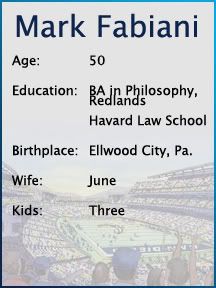
He is the master of the Chargers’ message to the community about putting a stadium in San Diego County. He represents the thoughts of the Spanos family that own and run the team, and is the point man for any public meeting that wants to talk stadium issues. While men like LaDainian Tomlinson and Shawne Merriman garner the most headlines, it is Fabiani’s words that are crucial to the future of the team.
The story of Mark Fabiani isn’t static to San Diego. Fabiani is well-traveled, well-known, and in several cases, infamous. His past hires range from politics to sports to entertainment, so much so that his personal history reads like a textbook. If the life of this 50-year-old is like that of a quarterback, Fabiani is not a training camp rookie. He’s an established veteran, a kickoff weekend starter.
This profile doesn’t dwell in policy and numbers. Walk into any of the speeches Mark Fabiani’s been giving over the last six years and the numbers will be sitting there. This is about the Mark Fabiani you don’t know. The Fabiani that picked up the pieces of Clinton’s broken home. The Fabiani that united with Dean Spanos by proximity before publicity. The Fabiani that gives more reasons why a stadium in Chula Vista doesn’t work than why it can.
This is why Mark Fabiani is an impact player.
If Mark Fabiani hadn’t settled in La Jolla, this article may not exist.
The Spanos family did not find Mark Fabiani by looking in the phone booth. The two sides had kept contact in bits and pieces starting in the late ‘90s. They may have never met, however, if the NFL hadn’t found Fabiani convenient.
“After I left the White House the NFL called me,” Fabiani said. “They said 'You handled all the problems for Clinton, would you like to give a Crisis Management presentation?’ They were holding the conference in San Diego, so it was an inexpensive choice for them.
“I guess they liked it and they mentioned me to the Chargers. I went over and met Dean and did some projects, nothing too significant. I did some smaller projects for them.”
But one day in April of 2002, Fabiani went from outside help to inside man.
“I got a call from Dean,” Fabiani recollected. “He said 'I need to see you right away.'
“But he said, 'No, come on over. Let’s meet over here and I can talk to you.’
 “We met at the lobby at the LaValencia Hotel and he told me, 'You’ve got to consider helping us on an issue.’ I said, 'What is that?’
He said, ‘We had a big meeting with our family and we decided we really want to try and keep the team in San Diego, but eventually we’re going to need a new stadium to do that. We don't need a new stadium tomorrow, or next week, or next year, but eventually we need a new stadium and it takes a while to get these things done and we want you to get started.’
“At the time, there were all these rumors about Los Angeles and a stadium being built in downtown. The team had moved its training camp to Carson.
“I said to Dean at the time, ‘You know, in my opinion, if you want to move the team, you should just move the team. You have a lease that allows you to do that. You're in a situation where it allows you to do that. If you just want to move the team, you should just move it.’
“And he said, 'I understand that, but that's not what I want to do. We want to try to keep the team here.’
“I said, "Your timing is not good. You've got a ticket guarantee that's making everybody mad. Your training camp is in Carson, and that’s making everybody mad. You've got a renovation that happened at Qualcomm in the ‘90s that the city is still paying for. People are not going to be anxious to be talking to us about a new stadium.’
“He said, ‘I understand that. We have a lot of things to do, and that's why we need to get started.’"
The real story of Mark Fabiani doesn’t start with meetings at fancy hotels. The story of Mark Fabiani starts with long stretches of brick buildings, open greens, nature trails and the hum of steel mills and limestone. His journey starts in Ellwood City, Pa.
“It's the cradle of the quarterback,” Fabiani said. “I lived in Beaver Falls, Joe Namath's hometown. We moved to California with my parents when I was a teenager, and we lived in Ontario.”
Even though Fabiani spent his teenage years in Southern California and graduated from the University of the Redlands, he still looked back to the East. His future was not set with a bachelor’s degree in philosophy. Something else needed to be done.
The answer? Harvard Law School.
“I went to college and a lot of my friends were going to law school, and at the time it seemed like the right thing to do,” Fabiani said. “I don't know if it was at the time, but it seemed like it was.
“At the time Harvard had the best law school. It was cold back there though. It was cold in Pennsylvania too, but I had live on the West Coast for a while. It was a shock. It was a good place to go to college. I wouldn't want to live there, but it was a great place to go.”
Like most graduated of law school, Fabiani dove into a firm and began his life as an attorney. But in the midst of a stable career, inklings of doubt began to crawl in his mind. The private sector was not holding his interest. A life of law firm service didn’t seem like the right direction.”
“I came back to the West Coast and clerked for a federal judge on the ninth circuit,” Fabiani said. “A great man named Stephen Reinhardt.”
Judge Reinhardt has only been appointed to the Ninth Circuit for a short time, having previously worked with the Los Angeles Police Commission. Before that, however, he worked with Tom Bradley, who at the time was the mayor of Los Angeles. And when Fabiani needed to regain focus, the judge knew exactly what direction to turn Fabiani.
“I ended up staying in LA and starting working in a law firm,” Fabiani said. “I didn't really like practicing law. I was kind of bored with it. So I went back to see my old friend and told him my situation. He said 'Well, I've got an old friend, Mayor Bradley, and he's looking for some help, and if you want to do something different, go talk to him. Fortunately he liked me, and I went to go work with him.”
Fabiani went to work, and his role of mixing private and public sector problems put him on the map. He became deputy mayor and chief of staff during the last four years of Bradley’s stay in office.
 Fabiani wouldn’t stay out of work long. He would jump from local politics to the big stage – working with President Clinton through the 1996 election. He was in front of the national media constantly discussing the Whitewater scandal. Along with that role, he helped shape strategies for the Clintons. He didn’t return to the public spotlight until the turn of the century when worked for Al Gore’s campaign as a strategist and spokesperson.
For Fabiani, working with the media is what has stayed the same throughout all his jobs.
“The principles are all the same - whether it's a sports job or a government job or a campaign,” Fabiani said. “You've got to understand that the media is delayed as the public gets information. You have to respect that people that work in the media. And by media, I now include the blog world and the message boards. You have to be willing to work with them, or else your information is not going to be able to get out. Whether it's any kind of issue, you've got to work with the people who generate the information.”
When asked whether he preferred the established position with Clinton or the unsettling and exciting campaign with Gore, Fabiani actually points to the Bradley days are most satisfying.
“When you're working in Washington, it's sometimes difficult to see if your job is producing any results,” Fabiani said. “You're far away from where things really happen at the local level. There's a lot of bureaucracy. My job with the mayor was a great job because everyday you could see if you were having ... a good effect of a bad effect on people. Washington was pretty far removed.
“A presidential campaign is totally different. You can measure on a day-to-day basis how you're doing. Whether you've got good press coverage, bad press coverage, you can look at how the crowds are. Immediate results are known to you.
“However, it's grueling. It's 20 hours a day, seven days a week for months and months and months. It's not something you can do forever.”
It was here that he met his future firm partner Chris Lehane. The two met in the White House, and their relationship carried over into a long-term – and infamous – partnership.
“I met him at the White House when I worked with Clinton,” Fabiani said. “I left for California, and he stayed and became Al Gore's secretary. I left and he stayed, but we obviously stayed in touch. I started on my own firm in 1997 in San Diego. I took a leave of absence to work on the Gore campaign. I worked for Gore until the bitter end in December, and then I joined up with Chris the following spring.”
Fabiani and Lehane have worked with a variety of people, including the NHL and filmmaker Michael Moore.
“[Chris is] a good guy, he's great to work with, and I feel fortunate to be able to work with him,” Fabiani said. “We've been fortunate to have a lot of interesting clients, interesting business, and I have no complaints.”
“For the first two years, our efforts were on cleaning up the mess.”
Fabiani’s start with the team wasn’t a time to relax. Work was to be done immediately, and he had to play catch-up for a situation already under duress.
“[There was] getting rid of the ticket guarantee,” Fabiani said, “getting rid of the trigger, getting rid of the litigation, getting rid of the bad relationship between the city and team and getting rid of the bad feelings between the team and the community about the ticket guarantee. I learned that quickly when I started giving speeches. It was a very difficult time.
The team worked with the city to solve the problems, giving each side the chance to finally listen to one another without anything in the way.
“We did clean them up finally,” Fabiani said, “and by the summer of 2004 we had renegotiated our lease with the city, we had eliminated the ticket guarantee and we had moved the training camp back. We had done everything they had asked us to do. We got our new lease signed, and the members of the City Council said ‘Now we can talk about a new stadium.’
“And then everything went to hell in a hand basket with the city.”
 The rest of the story doesn’t need to be retold here. The government collapsed, the stadium went on the backburner, and eventually the hope surrounding the project lowered faster than the sun setting over La Jolla Shores. Even now, with all eyes supposedly stuck on Chula Vista’s bayfront, the questions over Qualcomm have never quelled.
“The number one question I get is ‘Why not Qualcomm?’” Fabiani said. “It's like we worked on Qualcomm so long that people forget we worked on it.”
“The answer is pretty simple - when we proposed this … that proposal involved funding a project for a stadium that costs $400 million and infrastructure that costs about $175 million. But now, you're talking about a project that's going to cost double that. And how in the world, even if Mike Aguirre weren't around, even if Mayor Sanders suddenly became interested in our project, even if those issues went away - how in the world do you generate enough revenue off of the Qualcomm site to pay for that kind of huge project? You can't build 30,000 condos on the Qualcomm site. You can only do so much.”
“We would love to stay in Qualcomm. But the truth of the matter is that it doesn't work. If there was another source of funding, would it work? Yes, but there isn't.”
Six years after Fabiani signed on, more than a decade after meeting Dean Spanos, he’s still working on the same project he gave listening tours for, the same project he wrote statements on, the same project he has seen rise and fall. The stadium negotiations has come and gone from city to city, taking its imaginary pencil and crossing off each place it travels.
Now it sits at the bayfront’s shores and on the Eastside’s expanse. But is this southland ready to sign on the line instead of scratch off its name?
“We've got a lot of land,” Fabiani said. “You're talking about 130 acres on the waterfront. You're talking about 500 acres on the east side. It is very different from the Qualcomm site where you're trying to fit everything on 166 acres of land, only 60 acres of which are developable.”
Land is only one factor out of many other important topics. Land may be the only one Fabiani can cheerfully answer with full confidence.
“There are a lot of reasons why it might not work,” Fabiani said. “It might not work because there might not be a firm base for the shutdown of the power plant. It might not work because even if the plant is shut down, there might be environmental issues that might keep us from using the bayfront site. It might not work because you may never get through the gauntlet of government agencies that you've got to deal with, from the Coastal Commission to the Port Commission to various state agencies and the city of Chula Vista. That's something we have a difficult time explaining.”
And on top of that, someone has to foot the bill – and in California, don’t look at the taxpayers to fill the void.
“It might not work because no one's ever done this before, building a privately financed stadium,” Fabiani said. “It might not be possible to generate the efficient revenue to build [this]. The cost has clearly gone in the opposite direction of where we need it to be. You've got soaring construction costs. You've got a project that costs double what it costs six years ago.”
 But Fabiani does have hope on his side. Even thought the stadium project may not be the most famous thing he’s ever done, and even though it probably isn’t the most exciting thing he’s ever faced, it does has something for him to hang onto. For Fabiani, this project is a replica of how he likes to live his life.
Fabiani has never stuck to tradition. From going across the country once and back again, to not following in his Harvard footsteps, to working his way up the ladder in a way uncommon to most of his peers, why shouldn’t a stadium depending heavily on his voice take the most controversial route for its birth?
“Most people get out of law school and go into a law firm,” Fabiani said, “and I went into the government and it was the best choice I could have made. I don't really have any advice for anyone except ‘Don't always follow the traditional path. Sometimes you might do something that's out of the ordinary and it might turn out very well.’”
If an attorney is an envelope, Mark Fabiani can’t wait to deliver.
Tuesday, February 5, 2008
A Morning On The Bay
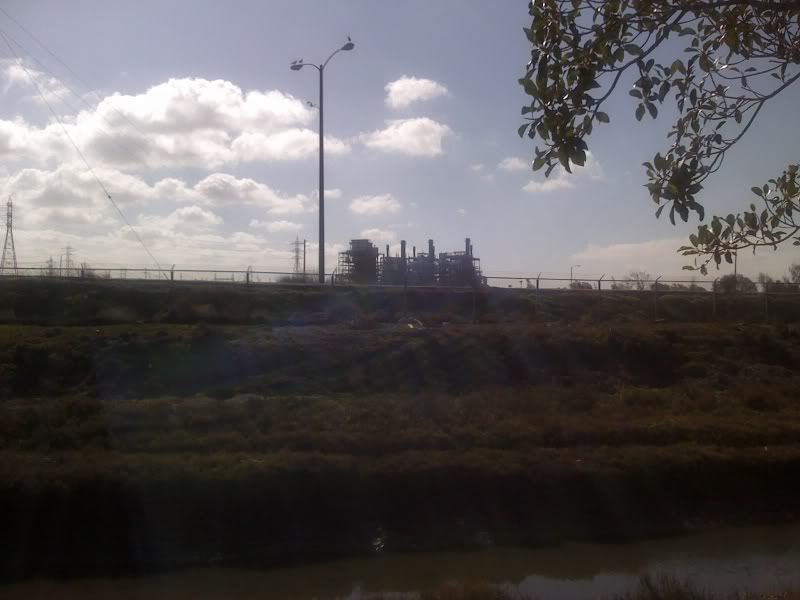
I stood on a rock listening to the sounds of the birds along the muddy banks as the smell of ocean coasted through the air on Bayfront Park.
Streaks of sun reflected down from the dull blue sky. The sound of the water slapping against the marsh was only broken in moments by fishing trucks driving along the road and planes roaring above. Dogs ran through grassy stretches while one man practiced Tai Chi along the water’s edge. People jogged and biked, boats launched, couples talked on benches. It was a morning removed from the hustle of life across the interstate. It was a momentary pause.
And across the wetland, guarded by a fence nearby and clouds above, the South Bay Power Plant stood. Silent yet pronounced, it stood there. It was impossible to ignore, easy to remember, and notable for a person making their first trip to the park.
I had to come here before I could really begin trying to talk about the issues that make up the situation. How could anyone approach tearing down a plant, cleaning up and putting in a stadium without actually seeing it from this perspective? Before you can talk about a power plant, you have to follow the power lines with your eyes coming down Interstate 5. Before you can talk about an environmentalist’s claims that a new stadium hurts local animals, you have to see a bird scrounging for brunch in the mud. Before you can talk to the County Department of Public Works about adding lanes, you have to hang a right at L St., park in the dirt and imagine if over 70,000 people could travel in and out of this place at that moment.
And that’s what it is about right now – the moment. That’s why it is so important to capture what those who make decisions both now and on a ballot have to say. What they think of now can change the way thousands used to think. Hearing a person one moment can change thousands more moments.
That’s why I keep promising to you that I’ll give you as many moments as I can if you keep giving me reasons to write them down.
A couple quick notes on that morning:
Even though I did not quote anyone on the existence of the South Bay Power Plant in a previous story, I could not find anyone who did not favor doing away with the 706-megawatt plant. One man called it “an eyesore” and that “getting rid of it is a good idea,” while another said he’d “love to see that plant go.” What wasn’t as clear was how they planned to compensate for the lack of emergency power. The plant is designated to power up to 500,000 Chula Vista homes in case of a power shortage. The battle for a new plant in South County existed before the stadium, and with the latest statements from the Public Utilities Commission, the battle isn’t settling down.
Traffic is another large concern. Interstate 5 and Bay Blvd. are the main vertical routes, and both connect to several smaller streets along the bayfront. The difficulty is that most of these streets run in single lanes – therefore, the quantity does not necessarily equal the quality. There is room for expansion along stretches of Bay Blvd, and space to add lanes on the bridges. However, the traffic situation will have to be revisited.
And as for the cleanup effort, the need stretches farther than what’s in the power plant. Driving through Bay Blvd., it was not hard to notice how much industrial work there is along the coastline. Placing anything as intense as a stadium requires the whole area to improve, and that includes making all of the bayfront impressive. Parts of the bay are far from that. Add that to the list of daunting tasks for the project.
And a quick note for the site: you’ve probably noticed the labels. Links are for pools of stuff to look at, headlines are for the “breaking news” angle, news is for the articles that I write, and feature is for the profiles and issues I write on.
Anything not making sense? Mail me.
Friday, February 1, 2008
Where You Are
“I believe the city missed the chance of developing the (Qualcomm) site. I believe our future is in Chula Vista. I'm hoping that, by June or July, we'll know more about Chula Vista. We have no plans to be anywhere else … I can't sit here and say something's going to get done, but we're going to reach a point where we know where we're at. The Spanos family wants to be in San Diego. I am not planning on an exit.”
-Chargers President Dean Spanos
San Diego Union Tribune, January 11, 2008
Sometimes it is best to start with what you aren’t before what you are.
This isn’t a blog meant to be a hype machine. It isn’t a website dedicated to the mission of building a billion-dollar stadium on the South Bay, no matter the issues, demand or cause. While the readers are allowed to champion the construction, I am not.
This also isn’t a blog meant to defame those who want a state-of-the-art building in San Diego County. It isn’t here to expose the Chargers as money-grubbing landlords who are ready to run out of San Diego with a one way ticket to Las Vegas or San Antonio. While the readers are allowed to run roughshod on Mark Fabiani and the Spanos Family, I am certainly not.
Then what is this blog? Simply put, it is an oasis in the desert of information surrounding a major project that will change the lives of all those in San Diego County. The people reading this blog will be able to understand the stadium project on a new level that will make them educated and ready when someone turns and asks: “What’s the deal with that stadium? Is it happening or not?” In a world currently dominated by presidential dealings, the keywords ring true – this blog is about change. Change for San Diego County. Change for the Chargers. Change for the Aztecs. Change for community dealings. Change for transit, police, fire, power, water, and the rest of the city services. Change for every denizen of the county.
How can this all happen? How can one blog make the person understand clearer than ever before? That is simple – by giving the viewer more than one way to see the issues. This blog will tell two stories, both intended for the readers to get the issues from two different perspectives.
The first is straight from the headlines. Some will come from local and national news organizations. Some will come from me. These can be bulletins or features, but they are intended to give information.
The second is from a personal distance. What are the real people talking about? It is not just about the talking heads in the major media. It is also about the ones that will talk in their homes, offices, bars and stores. How does someone from Chula Vista interpret what they see and hear? Whose message will ring clearer to them on Election Day? Would a freshman at San Diego State University feel comfortable taking the Blue Line all the way from the College Area to the Bayfront on a Saturday night? Does a person taking a walk along the marina respond positively when they imagine a stadium in their sightline rather than a power plant and a wetland? The first two news posts on this site will show what I mean by the two viewpoints.
Hopefully, as voting time nears, you will join me on this journey. Tell friends, tell family, tell strangers, tell Chula Vista residents. A power plant and a mesa stand as the last frontier between a new place to call home and trucks rolling away the last pieces of Chargers Park. Don’t let misinformation get in the way of progress, and don’t let misconception get in the way of discern.
This is Stadium Watch.


